Problem
Legal research is spread across contracts, filings and precedent. Keyword search returns documents; practitioners need defensible answers, and an answer without provenance is not usable in legal work.
Case study 01 · Legal intelligence
A citation-first research system that reads long legal documents, reasons across them, and answers with traceable evidence.

Legal research is spread across contracts, filings and precedent. Keyword search returns documents; practitioners need defensible answers, and an answer without provenance is not usable in legal work.
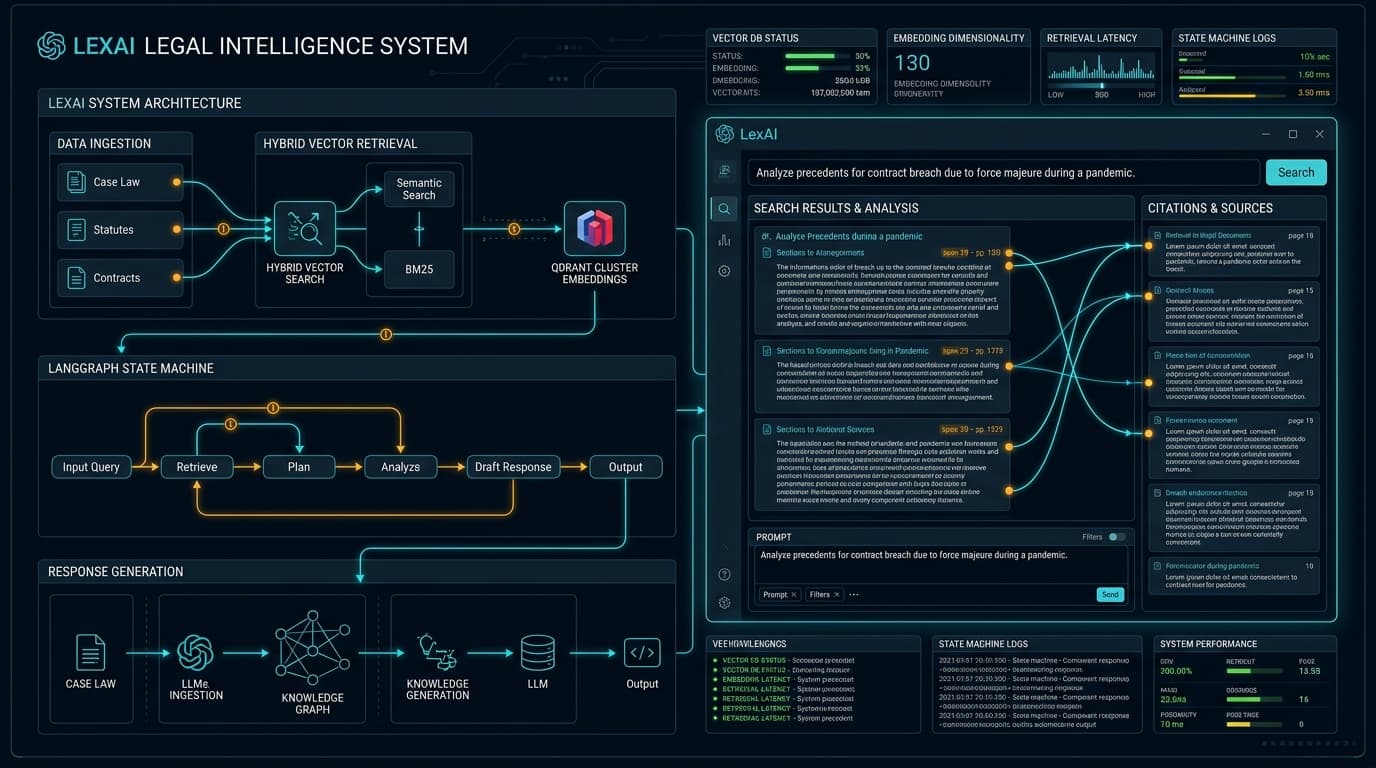
Documents are parsed along clause boundaries and indexed in Qdrant with both dense and lexical representations. A LangGraph agent works over that index with explicit tools for clause lookup, comparison and citation assembly.
Walk through the pipeline: select a stage, or use the arrow keys.
Contracts and filings are ingested with their structure (headings, clauses and cross-references) preserved.
Document
Contracts and filings are ingested with their structure (headings, clauses and cross-references) preserved.
Citations are a hard requirement, not a feature: every claim in an answer is pinned to the source span it came from. Claims that cannot be pinned are dropped, and when retrieval confidence is low the system refuses instead of guessing.
A golden dataset of question–answer–citation triples runs on every pipeline change, scoring groundedness, citation precision and refusal behaviour on questions outside the corpus.
Document analysis becomes a conversation that can be audited line by line: a reviewer can open any cited span and check the claim against the source.
Next step